
Brand story
Su, Richard and the beginning of SUQUEENA LONDON
Su and Richard co-founded London handbag brand SUQUEENA LONDON in 2015, bringing together her workshop experience and his interest in Welsh material history.
A collection of their own
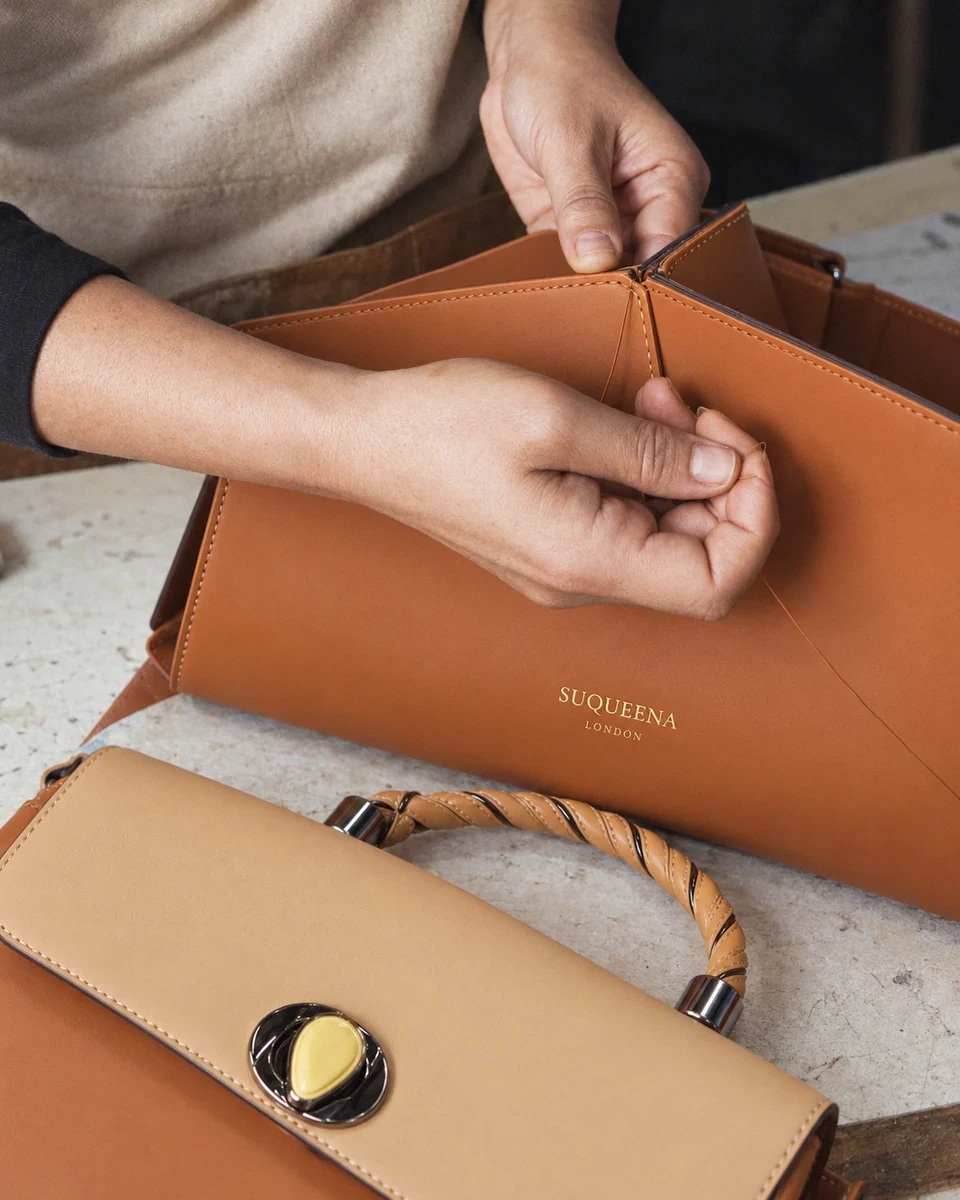
A handbag takes its character from a series of small decisions. The handle changes its outline; a clasp gives a flap its centre of gravity; the meeting of two colours can make a familiar shape feel unexpected. For Su, these are questions developed over twenty years of designing and making bags in China, including work for high-end labels.
Su and Richard co-founded London handbag brand SUQUEENA LONDON in 2015. The brand brings Su's workshop experience together with her British partner's eye for proportion and interest in the history of materials. Their first collection gives this conversation a form of its own.
The knowledge behind the shape
Working on bags means thinking beyond a drawing. A curve has to become a panel; panels have to meet; a handle must belong to the body beneath it. Su's contribution is an understanding of these relationships, built through years of workshop practice. The collection starts with recognisable forms and gives attention to the points where construction becomes visible.
Richard brings a British perspective to the partnership. His account of his family background has also drawn him to Welsh leather-making history. The surviving records offer a particularly rich subject: materials developed for specific jobs, and makers who understood that appearance and performance depended on how those materials were prepared.
A Welsh history of materials
An advertisement in Leather for Libraries, published in 1905, names J. Meredith-Jones & Sons at the Cambrian Leather Works in Wrexham as makers of bookbinders' leathers, with Welsh sheep a speciality. It also describes preparation following Society of Arts recommendations and excluding mineral acids. The emphasis is on suitability for a demanding use: protecting books that would be handled repeatedly.
The technical record adds another detail. H. R. Procter's The Principles of Leather Manufacture, published in 1903, describes a machine invented by J. Meredith Jones that supported skins on a rubber blanket stretched between two rollers. Procter noted its success with delicate skins. For Richard, this history offers an appreciation of practical ingenuity and sensitivity to a material.
An influence for the present
These archives provide a point of inspiration for the brand Su and Richard founded. What interests them is the attention behind an object: why a particular surface, outline or piece of hardware has been chosen, and how separate elements come together into a coherent whole.
The present collection is designed and made at Su's workshop in China, using vegan leather / PU. Its material is described plainly on the collection pages. The relationship with the Welsh archive is an interest in the culture of making, carried into a contemporary material and a new set of designs.
The first signatures
Across the collection, the Bond pairs an arched handle with a circular clasp; the Primrose has rounded handles and gently sloping sides; the Belgrave explores contrasting tones. Each offers a different balance of line, surface and detail. Together they introduce the visual language that Su and Richard are developing: composed shapes, colour with character, and a clear place for the handle and fastening in the overall design.
The collection, the studio series and the brand's own account of its beginnings can be explored at suqueena.com. This is the opening chapter of SUQUEENA LONDON, shaped by two people bringing different experience to the same object.
Sources & further reading
Press enquiries
info@suqueena.com